Description
Freestyle BL — AI-Powered Bioluminescence Image Analysis Software
Freestyle BL is a cloud-based 2D bioluminescence imaging (BLI) analysis platform developed by In Vivo Analytics. Designed for preclinical researchers and imaging scientists, it brings together AI-driven signal localization, longitudinal tracking, and cloud data management in a single browser-based platform — no software installation, no Excel, no custom scripting required.
AI Skeleton Overlay for Precise Signal Localization
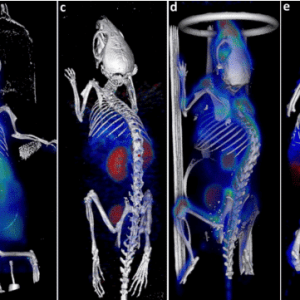
One of the most persistent challenges in 2D BLI is determining the anatomical origin of a bioluminescent signal. Freestyle BL addresses this with an AI model that automatically overlays an anatomically accurate skeleton onto each BLI image, co-localizing signal to specific body regions including the spine, limbs, thorax, and cranium. This eliminates the need for manual annotation, Fiji plugins, or imaging core support, and delivers reproducible localization results across your entire dataset.
Cloud-Based Data Management Built for Preclinical Studies
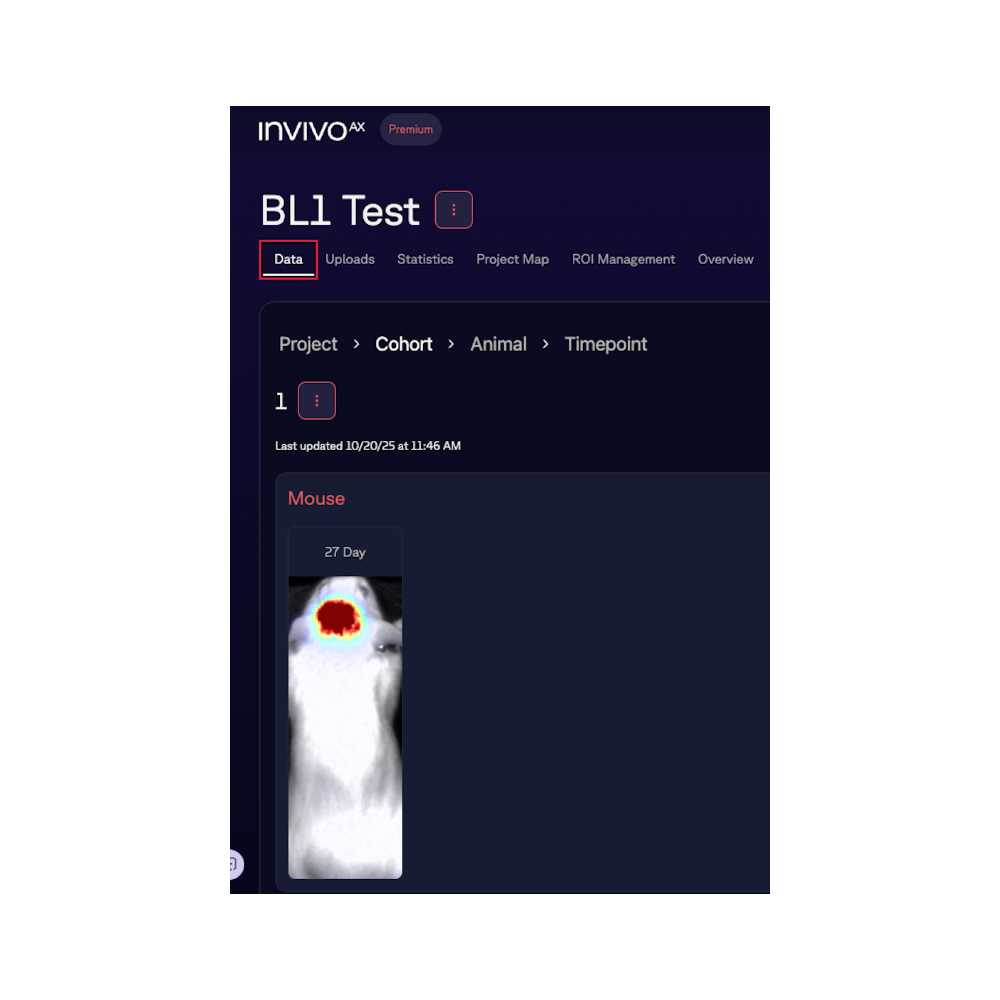
Freestyle BL is structured around how studies are actually designed. Upload your raw 2D BLI images and the platform automatically organizes them by project, cohort, animal ID, and timepoint in a secure cloud vault. Your entire study is accessible from any device at any time, with no shared drives, no file renaming, and no version control issues.
Longitudinal Tracking and Publication-Ready Outputs
Built-in longitudinal analysis tools allow you to visualize signal intensity over time — per animal, per cohort, or across an entire study. Regions of interest (ROIs) can be drawn and adjusted directly in the browser, with quantitative BLI measurements extracted instantly. Publication-ready charts and statistics are exportable in one click, without reformatting or additional data processing steps.
Who It’s For
Freestyle BL is designed for preclinical imaging labs running tumor burden studies, infection models, gene therapy research, and any application where longitudinal bioluminescence signal tracking is central to the study design. It is compatible with 2D BLI data from standard preclinical imaging systems, including the PRISM Bio-BOX.